

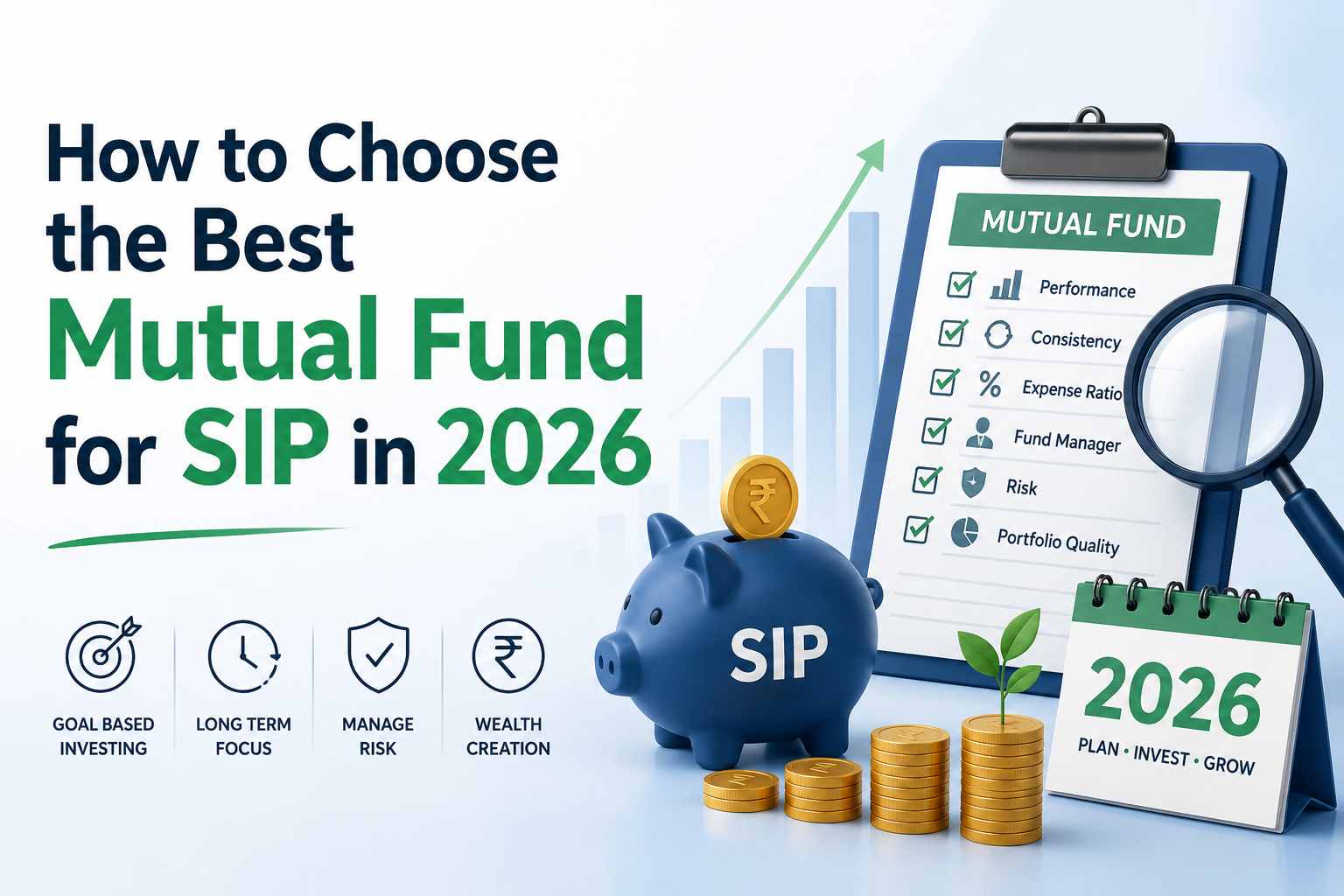
Starting a SIP, or Systematic Investment Plan, is one of the smartest moves you can make for long-term wealth creation. But with hundreds of mutual fund schemes available, choosing the right one can feel overwhelming. This guide breaks down everything you need to know to pick the best mutual fund for your SIP, whether you’re a beginner or a seasoned investor; selecting the best mutual fund for SIP can significantly impact your long-term financial goals.
With the growing popularity of online mutual fund investment, investors now have access to hundreds of mutual fund schemes at their fingertips. However, choosing the right fund can be overwhelming due to the vast number of options available in the market.
This comprehensive guide will help you understand how to choose the right mutual fund for SIP investments, evaluate different fund categories, assess risk factors, and make informed decisions that align with your financial objectives.
What is a SIP and why should you care?
A systematic investment plan is simply a disciplined way to invest in mutual funds. Instead of investing a large lump sum, you invest a fixed amount regularly — monthly, quarterly, or weekly. Think of it as a recurring deposit for mutual funds.
Why SIPs work:
- Rupee cost averaging: You buy more units when prices are low and fewer when prices are high. This averages out your purchase cost over time.
- Power of compounding: Your returns generate further returns. The longer you stay invested, the more your wealth grows.
- Discipline: SIPs force you to invest regularly, building a habit that pays off in the long run.
The best part? You can start a SIP with as little as ₹500 per month. That’s less than your monthly phone bill.
Also Read: How to Invest in Direct Mutual Funds (No Broker Needed)
Why Choosing the Best Mutual Fund for SIP Matters
Many investors focus solely on starting a SIP without paying enough attention to the fund they select. However, not all mutual funds perform equally. The success of your SIP depends largely on the quality of the mutual fund scheme.
The right mutual fund can:
- Generate superior long-term returns
- Match your risk tolerance
- Help achieve financial goals faster
- Provide portfolio diversification
- Protect wealth during market downturns
Choosing the wrong fund may result in lower returns, higher risks, and delayed financial goals.
Define Your Investment Goals
Before you pick any fund, ask yourself: Why am I investing?
- Are you saving for retirement (10-15 years away)?
- Building a down payment for a house (5-7 years)?
- Planning for your child’s education?
- Just looking to grow your wealth?
Your goal determines your investment horizon, which directly impacts which funds suit you best. For long-term goals (10+ years), equity funds make sense. For shorter horizons (3-5 years), you might want something more stable like hybrid or debt funds.
Short-Term Goals (1–3 Years)
For short-term goals, consider:
- Debt funds
- Liquid funds
- Ultra-short duration funds
Medium-Term Goals (3–5 Years)
Suitable options include:
- Hybrid funds
- Balanced advantage funds
- Conservative hybrid funds
Long-Term Goals (5+ Years)
For wealth creation over longer periods, consider:
- Large-cap funds
- Flexi-cap funds
- Index funds
- ELSS funds
- Mid-cap funds
Understand Your Risk Tolerance
This is where most investors mess up. They pick funds that sound exciting but don’t match their sleep-at-night comfort level.
Ask yourself:
- Can I handle a twenty to thirty percent drop in my portfolio without panicking?
- Do I need this money in the next five years?
- Am I investing for wealth creation or capital preservation?
Risk categories explained:
Conservative investors typically choose debt funds and hybrid funds. They offer lower returns but with minimal volatility. Moderate investors lean toward large-cap and flexi-cap funds, which balance growth with stability. Aggressive investors chase higher returns through mid-cap and small-cap funds, accepting higher volatility in exchange for growth potential.
Most financial experts recommend that flexi-cap funds should form the largest portion of your SIP portfolio, especially for beginners.
Look Beyond Past Returns
One of the most common mistakes new investors make is choosing a mutual fund solely based on its recent returns. It may seem logical to pick the fund that delivered the highest gains last year, but investing is rarely that simple.
Why Past Returns Can Be Misleading
A fund that performed exceptionally well in the previous year may have benefited from a temporary market trend or a booming sector. There is no guarantee that the same conditions will continue in the future.
Focus on Consistency Instead
Rather than chasing the highest returns, look for funds that have shown stable performance over time.
Consider the following:
- Performance across different market cycles
- Returns during both bull and bear markets
- Consistency over 3, 5, and 10 years
- Ability to manage market volatility effectively
Check the Fund Manager and the Fund House
The person actually managing your money matters more than most people realize. Look into how long the current fund manager has been running the scheme and what their track record looks like across other funds they manage.
A frequent change in fund managers can sometimes signal instability within the fund house.
It also helps to consider the reputation of the fund house itself. Established names like ICICI Prudential Mutual Fund have built a long track record across multiple categories, which gives investors a sense of consistency and experience to lean on.
The same goes for fund houses like HDFC and SBI. Once you invest, you can track your holdings anytime.
Just use the HDFC Mutual Fund login or the SBI Mutual Fund login on their respective portals. It makes monitoring your SIP straightforward.
This does not mean you should blindly pick a fund just because of the brand name, but a fund house with a long, transparent history is generally a comforting sign when you are trusting them with your money for years.
That Tiny Expense Ratio Is Quietly Eating Your Returns
The expense ratio is the annual fee your mutual fund charges to manage your money. It gets deducted automatically, so you never feel it directly, which is exactly why most investors ignore it.
On paper, it looks small. But over a 15-20 year SIP, that small number compounds against you year after year.
- Direct plans cost less than regular plans. No distributor commission means a lower expense ratio for the same fund.
- That gap adds up. Even a 0.5-1% difference, compounded over a decade, can mean a meaningfully smaller corpus.
- Compare like with like. An equity fund’s expense ratio shouldn’t be measured against a debt fund’s. Their cost structures are different.
- Recheck it yearly. Expense ratios shift over time, so it’s worth a glance during your annual portfolio review.
It’s not the flashiest line in your fund’s factsheet, but skipping past it is one of the easiest ways to quietly lose money.
Match the Fund Category to Your Timeline
Mutual funds come in several categories. Each one is built for a different kind of investor and a different time horizon.
Large cap funds invest in well-established, financially stable companies. They tend to be less volatile.
Mid cap and small cap funds chase higher growth. But they come with sharper swings along the way.
Flexi cap funds give the fund manager freedom to move across company sizes. The manager goes wherever the opportunities look strongest.
If you’re unsure where to begin, a flexi cap or large cap fund is usually a comfortable starting point. It works well for someone new to SIP investing.
As you grow more confident and your goals stretch further into the future, you can start exploring mid cap or small cap exposure too. Just a bit of extra growth potential layered in once you’re ready for it.
Use a Mutual Fund Calculator Before You Decide
Numbers on a screen rarely feel real until you actually see them play out. This is where a mutual fund calculator becomes genuinely useful.
Instead of guessing how much your monthly SIP might grow into after ten or fifteen years, you can plug in different amounts and tenures to get a realistic picture.
Playing around with a calculator for a few minutes often gives people a much clearer sense of what they are actually working toward.
It also helps you decide whether you need to increase your monthly contribution slightly to reach a specific goal comfortably, rather than discovering that gap years later when it is harder to fix.
Diversify Instead of Putting Everything in One Basket
It is tempting to find one great fund and pour all your SIP money into it, but spreading your investments across a couple of well-chosen funds from different categories usually works out better.
This does not mean owning ten funds that all do the same thing, which just adds confusion without adding any real benefit.
A simple, well-balanced portfolio might include one large cap or flexi cap fund for stability, paired with a mid cap fund for growth, and perhaps a debt fund if you want a cushion against volatility. The goal is balance, not quantity.
Keep an Eye on the Fund’s Portfolio Composition
Every fund publishes a list of where it has actually invested your money. It’s called the portfolio composition, and it’s worth a quick look every few months.
This list tells you which sectors and companies the fund manager is betting on. Sometimes the real picture doesn’t match what the fund’s name suggests.
A few things to watch for:
- Check the sector spread. If a fund is supposed to be diversified but you notice it’s heavily concentrated in just one or two sectors, that’s a red flag worth noting.
- Don’t just trust the label. A fund named “diversified equity” can still carry concentrated risk if you don’t look under the hood.
- Know what you actually own. The real risk you’re carrying might be different from what you assumed when you first invested.
- A quarterly glance is enough. You don’t need to study this every week. A periodic check is all it takes.
At the end of the day, this is about staying aware of what you actually own, not just trusting the name printed on the fund.
FAQs
- What exactly is a SIP?
Think of a SIP as a way to invest a small amount of money in a mutual fund every month instead of investing a large sum at once. - How much money do I need to start a SIP?
Not much at all. Many mutual funds let you start with just ₹500 per month. - I’m a beginner. Which type of fund should I choose?
If you’re just starting out, a large-cap or flexi-cap fund is usually a good place to begin. - Should I pick the fund that gave the highest returns last year?
Not necessarily. It’s usually smarter to look for funds that have performed consistently over several years. - Can I stop my SIP if I need the money later?
Yes, absolutely. Most SIPs are flexible, so you can stop, pause, or modify them whenever needed. - Why should I use a mutual fund calculator?
A mutual fund calculator helps you see how your investments could grow over time and whether you’re on track to reach your goals.
Final Thoughts
So here’s the deal—don’t let that tiny percentage fool you. It looks like nothing today, but years from now? It could be the difference between a good retirement and a great one.
The best part?
You’re in control.
Just pick direct plans when you can, compare funds in the same category, and check that expense ratio before you click “invest.” It takes two minutes, tops. Think of it like this: you’re already doing the hard work of saving and investing.
Why hand over more of your money than you absolutely have to? Keep costs low, stay consistent, and let time do its magic. Your future self isn’t going to care about fund manager names—they’re going to care about that bigger corpus. So be kind to that future version of you. Trim the fees, stay curious, and keep going. You’ve got this!
Related Posts

Absolute Return: Meaning, Formula & Best Funds to Invest In (2026)

These Direct Mutual Fund Apps Gives the Highest Returns
