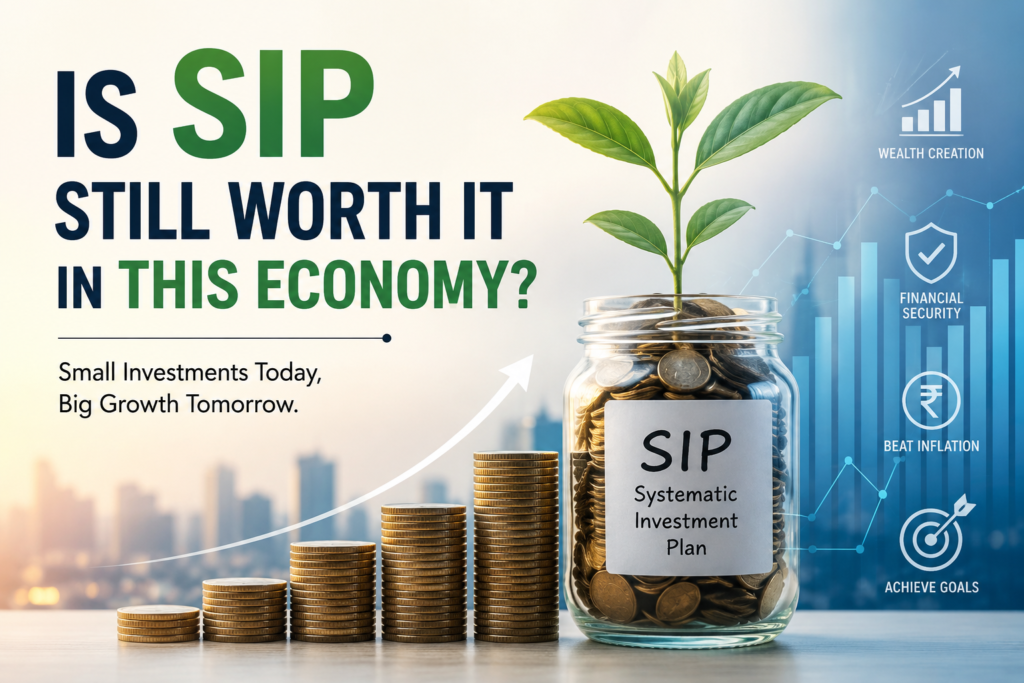


Whenever we think about investing or try investing, the two things that come to our minds are ‘SIP vs mutual funds: which is better?‘ But the question that comes most often is – are mutual funds and SIPs the same, or are they different? And the surprising part is most people don’t know the answer.
Honestly, this confusion is everywhere. Search “difference between SIP and mutual funds“, and you’ll find people arguing both sides; some insist SIP and mutual funds are same, others go completely south. They are used so side by side that their difference has become a mystery that no one seems eager to solve.
Take a deep breath. We’re going to break this down in plain. By the end of this, you’ll never confuse the two again, and you’ll know exactly which route to take. By the end of this article, you’ll know exactly what SIP is, what a mutual fund is, how they connect to each other, and SIP vs mutual fund is different — the question everyone really wants answered — whether to choose SIP or go with mutual funds for long-term goals in 2026.
What is SIP?
SIP full form is Systematic Investment Plan. It is a method of investing. In SIP instead of putting in a huge amount of money all at once, you invest a fixed amount at regular intervals—usually monthly. So if you decide to invest ₹5,000 through an SIP, that amount gets automatically deducted from your bank account every month and invested on your behalf.
Here’s how it actually works behind the scenes. Every time your SIP amount goes in, it buys units of a mutual fund scheme at that day’s NAV (Net Asset Value). Since markets move up and down, some months your ₹5,000 buys more units (when prices are low), and some months it buys fewer units (when prices are high).
Over time, this evens out your average purchase cost, a concept commonly called rupee cost averaging. It’s one of the quiet superpowers of investing through SIP, because you’re not trying to guess the “perfect” time to invest. You just show up, month after month, and let the math work itself out.
The main point to remember here is that SIP is a method and not a product. You simply can’t “buy an SIP” the way you buy a mutual fund. What you’re actually doing is using the SIP route to invest in a mutual fund scheme.
What Is a Mutual Fund?
Now let’s flip to the other side of the equation. A mutual fund is a pooled investment vehicle. In plain words, it’s a collective pot of money gathered from thousands of investors like you, which is then invested across stocks, bonds, or other securities depending on the fund’s stated objective.
This pool is handled by a fund manager. The fund manager is a qualified professional who researches, selects, and manages the underlying investments so that individual investors don’t have to track every single stock or bond themselves from time to time. You’re essentially trusting someone with expertise to make these decisions on your behalf, in exchange for a small management fee.
In a simpler manner, a mutual fund is the destination, and SIP is one of the routes you can take to reach that destination. You could also reach the same destination through a lump-sum investment – putting in the entire amount in one go instead of spreading it out. Both roads lead to the same mutual fund scheme; but both of them have different styles of getting there.
The Big Myth: Are SIP and Mutual Funds the Same?
The most common question and the common confusion is whether SIP and mutual funds are same. Sorry to burst your bubble; they are not.
I know, I know—you’ve probably heard people use these words interchangeably more times than you can count. But here’s the truth that changes everything.
Think of it like this. You have a destination, and you have a vehicle.
The destination is the mutual fund. It’s the actual investment product you’re buying into. When you invest in a mutual fund, your money gets pooled with thousands of other investors and professionally managed across stocks, bonds, or other assets.
The vehicle is the SIP (Systematic Investment Plan). It’s the method you use to get there. Instead of trying to save a massive sum and investing it all at once, you invest smaller amounts regularly, like monthly instalments.
Here’s where it clicks: When people say they want to do a “SIP”, what they really mean is they want to invest in a mutual fund using the SIP method. You simply can’t have a SIP without a mutual fund to put it into. It’s like saying you want to take a car ride but without a destination – it doesn’t work!
So, while they’re deeply connected (almost like best friends), they are definitely not the same thing. A mutual fund is the product, while a SIP is just one of the many ways you can buy it. And guess what? You can also invest in mutual funds through a lump sum (one big payment).
SIP vs. Mutual Funds: Key Differences
Since SIP and mutual funds aren’t really competing concepts — one is a method and the other is a product — comparing them side by side helps make the relationship crystal clear.
| Aspect | SIP | Mutual Fund |
| What it is | A method of investing at fixed intervals | An actual investment product/scheme |
| Payment style | Small, fixed amounts paid periodically | Can be invested via SIP or lump sum |
| Best suited for | Salaried individuals, beginners, disciplined investing | Anyone with a lump sum or ongoing surplus |
| Risk handling | Reduces timing risk through cost averaging | Risk depends on the fund’s underlying assets |
| Flexibility | Can pause, increase, decrease, or stop anytime | Choice of category (equity, debt, hybrid, etc.) |
| Ideal horizon | Works well for long-term, goal-based investing | Depends on the specific scheme chosen |
Looking at this table, the pattern becomes obvious — you’re not really choosing between SIP and mutual funds. You’re choosing a mutual fund and then deciding whether SIP or lump sum is the better way to invest in it.
Benefits of Investing in Mutual Funds
We all invest our money in the mutual funds to get good returns in the end. So everything comes down to choosing a solid mutual fund. And how are you going to do that? Given below are some of the most important points you should remember while doing mutual funds investment.
Diversification: Your money gets spread across multiple stocks or bonds instead of being tied to just one company, which cushions the blow if any single investment underperforms.
Professional management: You get the benefit of a fund manager’s research, market experience, and full-time attention – something most individual investors simply don’t have the time to replicate on their own.
Category choice: Whether your goal is aggressive growth, steady income, or something balanced in between, there’s likely a mutual fund category built for it—equity, debt, hybrid, or gold funds, to name a few.
Liquidity: Barring a few exceptions like ELSS funds with a lock-in, most mutual funds investments allow you to redeem your investment fairly easily, giving you access to your money when you actually need it.
How to Invest in Mutual Funds (Step-by-Step Guide)
After learning about investing in mutual funds, here’s a simple roadmap for your mutual funds investment journey.
- Define Your Goal: What are you investing for? Is it retirement, a child’s education, a dream home, or just building wealth? Your goal decides the type of fund you need. A fixed goal with a clear mind will help you find your dream goal.
- Choose Your Route (SIP vs. Lump Sum): Beginners usually go for SIP because it is easier to invest in SIP when you have just started. Also, it’s easier on the wallet and helps you manage risk.
- Select a Fund Category: Whenever you want to invest, you will always come across three options. Large companies (large-cap), small companies (mid/small-cap) or a mix of both. This totally depends on your risk appetite.
- Complete Your KYC: A KYC, or Know Your Customer, is a very important step before investing. You need to complete your KYC formalities with a mutual fund house or a broking platform. This is a simple online process.
- Pick a Platform: You can invest directly through the asset management company (AMC) website or through online platforms like Groww, Zerodha, or Paytm Money.
- Set Up Your SIP: Choose the date and amount you want to invest, and the money will be auto-debited from your bank account. Monthly SIP is the most common among investors.
- Review Periodically: Don’t just “set and forget”. Review your portfolio once a year to ensure it’s still aligned with your goals. This will give you a clear picture of which of your investments is working well and which one is lagging behind.
What Are the Best Mutual Funds to Consider?
This is the million-dollar question! The answer to the best mutual funds is tricky because there is no one-size-fits-all. A fund that’s great for me might be terrible for you.
Instead of looking for a top 10 list, which changes from time to time, look for the best mutual funds by category that suit your risk profile.
The Main Categories for 2026
- Large-Cap Funds: These invest in the top 100 companies by market capitalisation. They are relatively stable and less volatile. They are a good core holding for your portfolio.
- Flexi-Cap Funds: These give fund managers the freedom to invest anywhere they see the best opportunity—be it in large, mid, or small companies.
- Mid & Small-Cap Funds: These invest in medium- and small-sized companies. They have the potential for massive growth but are much more volatile. These are for investors with a higher risk appetite and long time horizons.
- Hybrid Funds: These invest in a mix of equity and debt. They are great for beginners or conservative investors who want to dip their toes in equity but have a safety net of debt.
The most common mistake people make while investing is going after the last “best performer”. This may work for most or may not. Instead of going that way, check for consistency of returns across market cycles, the fund manager’s track record, and the fund’s expense ratio.
SIP or Mutual Fund: Which Is Better for the Long Term?
After reading the whole blog, we have come to the main point—sip or mutual fund which is better for long term?
So here’s the answer.
Think of it like buying a car. The mutual fund is the car itself—the actual vehicle that takes you toward your financial goals. SIP is simply the fuel-filling method you choose: steady, small refills instead of one giant tank filled up front. You still need the car (the mutual fund) to go anywhere. The fuel method (SIP) just determines how smoothly and steadily you get there.
For most long-term individual investors, especially salaried professionals with a monthly income, SIP tends to be the more practical route. It matches naturally with how income actually flows in, removes the stress of timing the market, and builds a habit that compounds quietly in the background for years.
Lump sums do make sense in some situations. Like when you’ve received a bonus or your savings matured from another investment, and markets happen to be at a reasonably attractive level. In such cases, deploying that money in one go, rather than trickling it in slowly, can sometimes work in your favour.
So the real answer isn’t “SIP vs. mutual funds”. It’s “Should I invest in this mutual fund via SIP or lump sum?” and for the average long-term investor building wealth steadily over the years, SIP usually wins out.
FAQs
- Is SIP better than mutual funds?
Not quite the right comparison, since SIP is a method and a mutual fund is the product. The real question is SIP vs. lump sum, and SIP usually wins for regular-income investors.
- Can I stop my SIP anytime?
Yes. You can pause, stop, increase, or decrease your SIP amount whenever you want, with no major penalty in most cases.
- What is the full form of SIP?
SIP full form is Systematic Investment Plan.
- What is the minimum amount to start an SIP?
You can start an SIP with as little as ₹500 a month, which makes it easy for beginners to get going.
- Do SIP returns depend on the mutual fund I choose?
Yes. SIP is just the investment method, so your actual returns depend entirely on the mutual fund scheme behind it.
- Is SIP safe for beginners?
SIP doesn’t remove market risk, but it does reduce timing risk, making it a fairly beginner-friendly way to start investing.
- Can I have multiple SIPs running at once?
Yes, you can run several SIPs across different funds at the same time, which is a common way to build a diversified portfolio.
Conclusion
At the end of the day, SIP and mutual funds aren’t rivals fighting for your attention — they’re partners working together toward the same goal. The mutual fund is where your money actually grows; SIP is simply the disciplined, steady way many investors choose to get it there. Once you see them as a team rather than a contest, the whole “SIP vs. mutual funds” debate quietly disappears.
Related Posts

Best App for Mutual Funds Investment in 2026

Best SIP Plan for Under ₹1000 in India (2026): Top Mutual Funds, SBI SIP Plans & Beginner’s Guide