

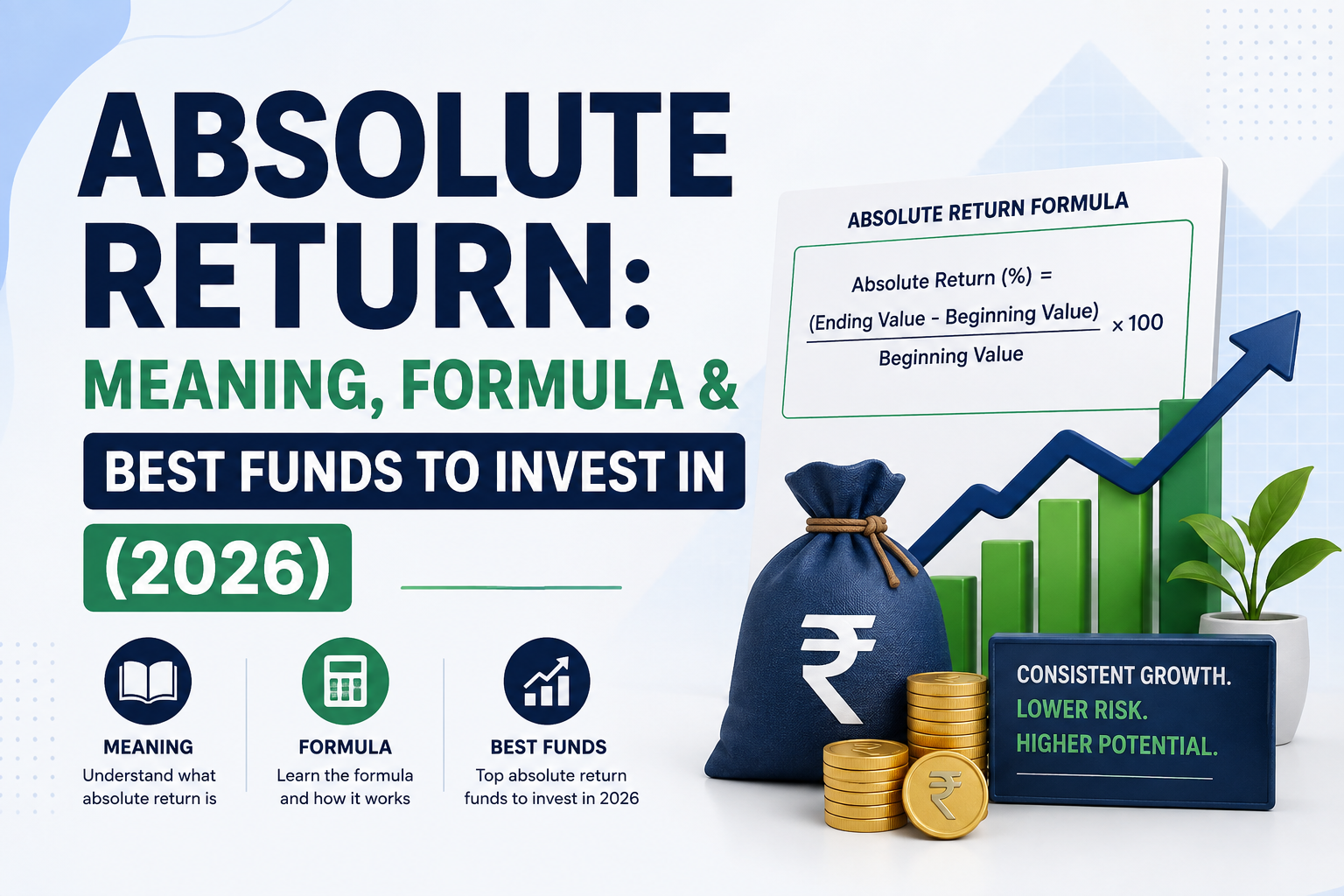
Ever heard someone say, “I don’t care what the market does; I just want my money to grow”? That’s basically the whole idea behind absolute return. No benchmarks, no comparing yourself to the Nifty or Sensex — just plain, positive growth, year after year.
If you’re someone who gets a little anxious watching the market swing up and down, this concept might genuinely change how you invest. Let’s break it down in the simplest way possible.
What Is Absolute Return?
So what does absolute return meaning actually mean? It’s the real, total return an investment generates over a specific period — no comparison, no benchmark, just the plain percentage gain (or loss) on your money.
Compare that to relative return, where your fund is measured against an index. If the Nifty loses 10% and your fund falls just 5%, a relative-return investor could label that a gain. An absolute-return investor won’t be pleased. They just worry about one thing: did my money genuinely grow?
That’s why absolute return is attractive to conservative investors, retirees, or anybody else who seeks stable, predictable gain rather than a rollercoaster ride. It’s not about outperforming the market. It’s about quietly growing wealth, rain or shine, without losing money.
Think of a farmer who is indifferent to whether his neighbour’s wheat crop is up 20% this year. He simply wants his pitch to constantly come up every single season.
Check Out: What’s the Percentage of Profit in SIP? Here’s the Answer
Absolute Return Formula (With a Simple Example)
The formula for absolute return is:
Current Investment Value − Initial Investment Value
Absolute Return = ——————————————————————— x 100
Initial Investment Value
- Current Investment Value = The present value of your investment
- Initial Investment Value = The amount originally invested
The absolute return formula calculates the change in percentage between the starting values and the current value.
Example:
Let’s say you invested ₹1,00,000 in a fund, and after 2 years, it’s worth ₹1,25,000.
1,25,000 − 1,00,000
Absolute Return = ——————————————————————— x 100
1,00,000
= 25%
One thing to keep in mind: this calculation only tells you the total return, not the yearly rate. If you want to know how much your money grew per year, CAGR is the number you’re actually looking for.
How to Calculate Absolute Return Step by Step
If the numbers still seem a little overwhelming, just break them down like this:
Step 1: Write down your investment. How much did you invest?
Step 2: Check your fund statement or broking app for the current value of that investment.
Step 3: Subtract the original amount from the present value. That’s your true profit/loss.
Step 4: Take that figure and divide it by your original investment.
Step 5: Multiply your answer by 100 to obtain a percentage.
A positive number suggests you are in profit. A negative one signifies you’re losing. That’s the whole procedure.
Why absolute return matter?
Once you actually get the absolute return meaning, you start to see why so many seasoned investors lean on it. Most of us were taught to measure success by comparing ourselves to something — the market, a friend’s portfolio, or a neighbour’s FD rate. Absolute return quietly removes that comparison from the equation.
It matters because your actual life goals don’t care about benchmarks either. If you’re saving for a wedding, a house down payment, or your child’s college fund, “my fund beat the Nifty” doesn’t pay the bills. What matters is whether your money actually grew enough to meet that goal. That’s the entire point of thinking in absolute terms — it keeps your focus on real, usable growth instead of bragging rights.
It also matters during rough market phases. When headlines are screaming about a crash, an absolute-return mindset asks a calmer question: is my money still growing, even if slowly? That shift alone can save you from panic-selling at the worst possible time.
There’s also a behavioural angle here that doesn’t get talked about enough. Constantly comparing your portfolio to an index creates a kind of restlessness. You start second-guessing every dip, every green day for the market that your fund missed, and every “better” option a friend mentions at a dinner party. Absolute return thinking removes that noise. You check one number, your own growth, and move on with your day. For a country where a huge chunk of investors are first-timers still building trust in the markets, that mental calm is worth just as much as the returns themselves.
And honestly, it matters for goal-based planning too. If you know you need ₹10 lakhs in 5 years for a specific purpose, working backward from an absolute return target tells you exactly how much to invest and where. Relative return, by contrast, tells you how you’re doing versus the market, but not whether you’re actually on track for your number.
Also Read: 9 Types of SIP Investments You Should Know Before You Invest
Benefits of Absolute Return
Here’s what makes this approach genuinely useful, not just a nice-sounding concept:
1. Clarity over confusion
You don’t need to track five different indices to know if you’re doing well. One number, your growth, gives you the full picture.
2. Better decision-making
When you’re not obsessing over “beating the market”, you make calmer, more rational choices instead of chasing whatever’s trending.
3. Works in any market condition
Bull run or bear market, the absolute return lens stays the same. You’re always asking the same simple question: did my money grow?
4. Encourages capital protection
Because the focus is on real growth rather than relative outperformance, absolute-return strategies naturally lean toward protecting your downside first.
5. Easier to explain to yourself (and your family)
Try explaining “alpha” or “beta” to a parent who just wants to know if their money is safe. My investment grew 12% this year” is something everyone understands immediately.
6. Better suited for milestone-based goals
Weddings, education, and a down payment — these goals have fixed dates and fixed amounts attached. Absolute return numbers map directly onto that math, without needing to translate a benchmark comparison into rupees you can actually use.
7. Removes the temptation to chase performance
A lot of investment mistakes come from jumping into whatever fund topped the charts last year. Thinking in absolute terms keeps your eyes on your own steady progress instead of last quarter’s headlines.
Absolute Return vs Relative Return
This comparison trips up a lot of new investors, so let’s clear it up once and for all.
| Absolute Return | Relative Return | |
| What it measures | Actual gain or loss on your money | Performance compared to a benchmark |
| Benchmark needed? | No | Yes (like Nifty 50, Sensex) |
| Can still be “good” during a loss? | No, a loss is a loss. | Yes, if you lose less than the benchmark |
| Best suited for | Conservative investors, medium-term goals | Investors comfortable with market-linked ups and downs |
| Typical funds | Balanced advantage, dynamic asset allocation | Equity mutual funds, index funds |
The simplest way to remember it: absolute return investors ask, “Did I make money?” Relative return investors ask, “Did I do better than the market?” Both are valid ways to invest, but they serve very different personalities and goals.
Here’s a scenario that illustrates the difference. Say the market falls 15% in a bad year. A relative-return fund manager might proudly report that their fund only fell 8%, “beating” the index by 7 percentage points. This is technically true and reflects genuinely skilled fund management. But if you’re the investor who needed that money this year, an 8% loss still hurts, no matter how good it looks on a relative basis.
An absolute-return fund, by design, is built to try and stay positive, or at least close to flat, in that same scenario. Neither approach is wrong, but they’re solving for very different things, and knowing which one you actually want matters more than most people realise before they invest.
Limitations and Considerations of Absolute Return Investing
As much as this strategy has going for it, it’s not a magic fix, and it’s worth going in with clear eyes.
Lower upside in strong bull markets
Since the whole point is stability, you’ll likely underperform pure equity funds when the market is on a strong upward run. You’re trading some potential gains for peace of mind.
Higher costs in some cases
Active hedging and dynamic allocation require skilled fund management, which can mean higher expense ratios compared to a simple index fund.
Strategy execution matters a lot
Two absolute-return funds using similar strategies can perform very differently based on how well the fund manager times their calls. Manager skill genuinely moves the needle here.
Not entirely risk-free
“Absolute return” describes the goal, not a guarantee. In extreme market conditions, even well-managed absolute-return funds can post a negative year.
Requires patience
This isn’t a get-rich-quick approach. The real benefit shows up over 3–5 years of steady, unglamorous compounding, not in a single spectacular quarter.
Harder to evaluate at a glance
Because there’s no benchmark to compare against, it takes a bit more effort to judge whether a fund is actually doing well. You have to look at rolling returns, downside capture, and consistency over time, rather than a simple “beat the index” headline number.
Tax treatment still applies normally
Don’t assume the “absolute” label changes how gains are taxed. These funds are taxed based on their underlying asset allocation (equity or debt-orientated), just like any other mutual fund, so factor that into your actual take-home returns.
Going in with these limitations in mind helps you set the right expectations from day one, so you’re not disappointed when your absolute-return fund doesn’t triple in a bull run, that’s simply not the game it’s playing.
FAQs
1. What is the difference between absolute return and relative return?
Absolute return is your actual gain or loss. Relative return compares you to a benchmark, even if you still lost money.
2. What is a good absolute return percentage?
8–12% annually is considered solid for conservative strategies in India.
3. Are absolute return funds safe?
Lower-risk than pure equity funds, but not risk-free.
4. Can I calculate absolute return for SIP investments?
Not accurately. Use XIRR instead, as it accounts for multiple instalment dates.
5. How is absolute return different from CAGR?
Absolute return shows total growth. CAGR annualises it, so you can compare different time periods fairly.
6. Which is better for retirement — absolute return or equity funds?
Equity funds suit a long horizon. Absolute return suits capital protection closer to retirement.
7. Do absolute return funds guarantee positive returns every year?
No. They aim to minimise losses, but a negative year is still possible.
Conclusion
At the end of the day, absolute return investing is about one simple promise to yourself: steady, positive growth without the stomach-churning ups and downs of the market. Whether you’re choosing absolute return funds, building your own absolute return portfolio, or just trying to understand the absolute return formula, the goal remains the same: protect your capital first, then grow it steadily. It won’t make you the richest investor in the room, but it might just help you sleep better at night, and for most people, that’s a trade worth making.
Related Posts

How to Choose the Best Mutual Fund for SIP in 2026

These Direct Mutual Fund Apps Gives the Highest Returns
